Exploring Golden Bay: A Gentle Search for Foundation Land
-
NeighbourGood NZ

- Sep 2, 2026
- 5 min read
This sits alongside our impact investor invitation, Landing Zone vision, and Living Manifesto — the land question, asked gently, to the people who know Golden Bay best.
Land does not wait for perfect timing — and neither do the people who dream of building somewhere to belong. NeighbourGood is quietly exploring land options in Golden Bay: not a hard purchase push today, but an open conversation with locals who know a paddock, a valley, or a title that might one day become home for a regenerative village.
We do not have purchase capital in hand yet. What we do have is a shortlist of criteria, a willingness to listen, and a plan to test real properties against what a NeighbourGood village actually needs. Think of this less as a classified ad with a cheque attached, and more as a letter to neighbours: if you have land, or know someone who does, we would love to hear what you see from your side of the fence.
Why Golden Bay — and why now, softly
Golden Bay has drawn us for years: a community-minded corner of Te Tau Ihu with room for regenerative agriculture, access to bush and coast, and a culture that already understands alternative living. Land here is finite. Titles change slowly. Families hold blocks for generations. Starting the conversation early — before money arrives — means relationships can grow at human pace.
We are also placing a short notice in the local newspaper: a compact form for landowners who would rather pick up the phone than scroll a website. Not everyone is online; many of the best leads come from morning cups of tea and word passed at the market.
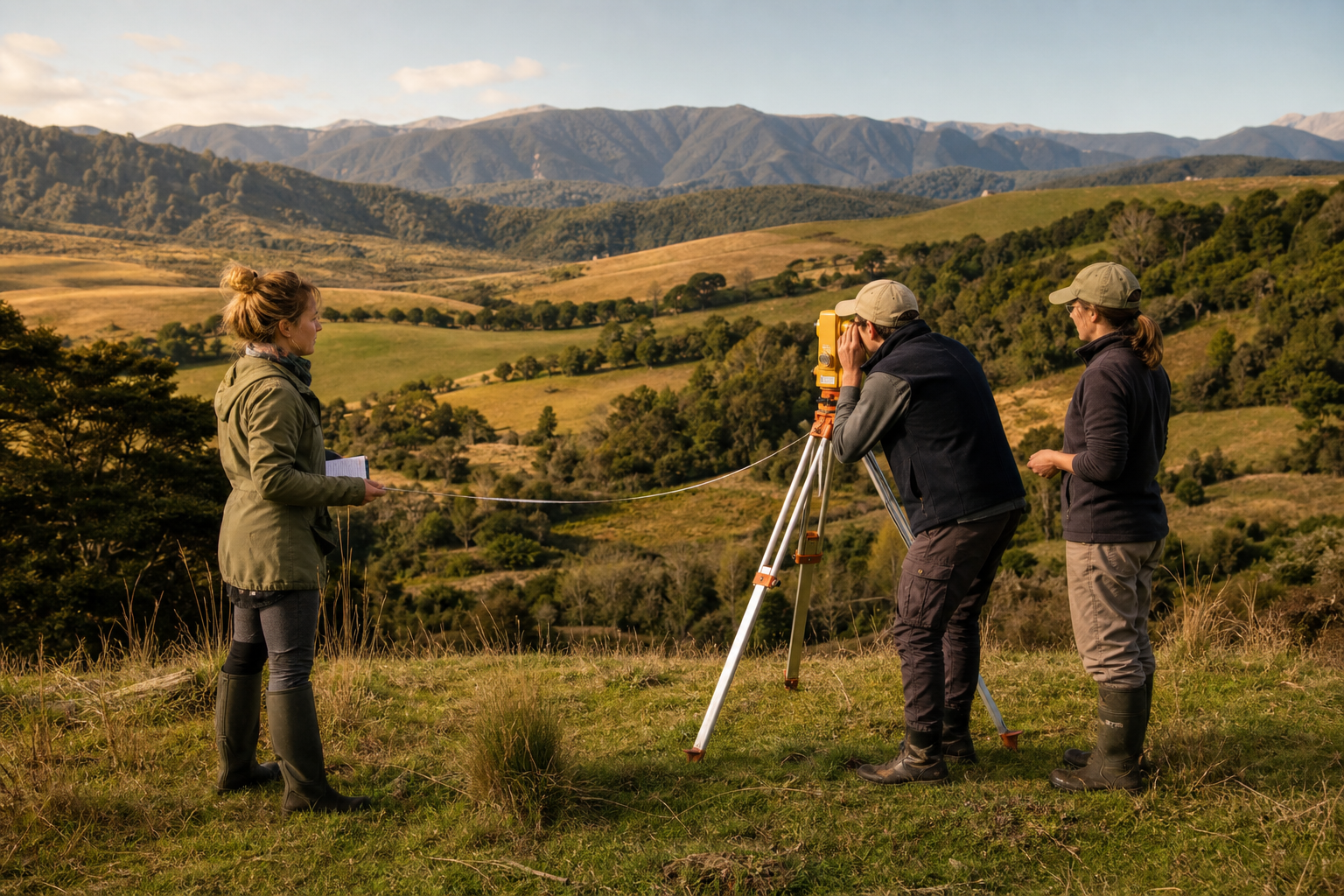
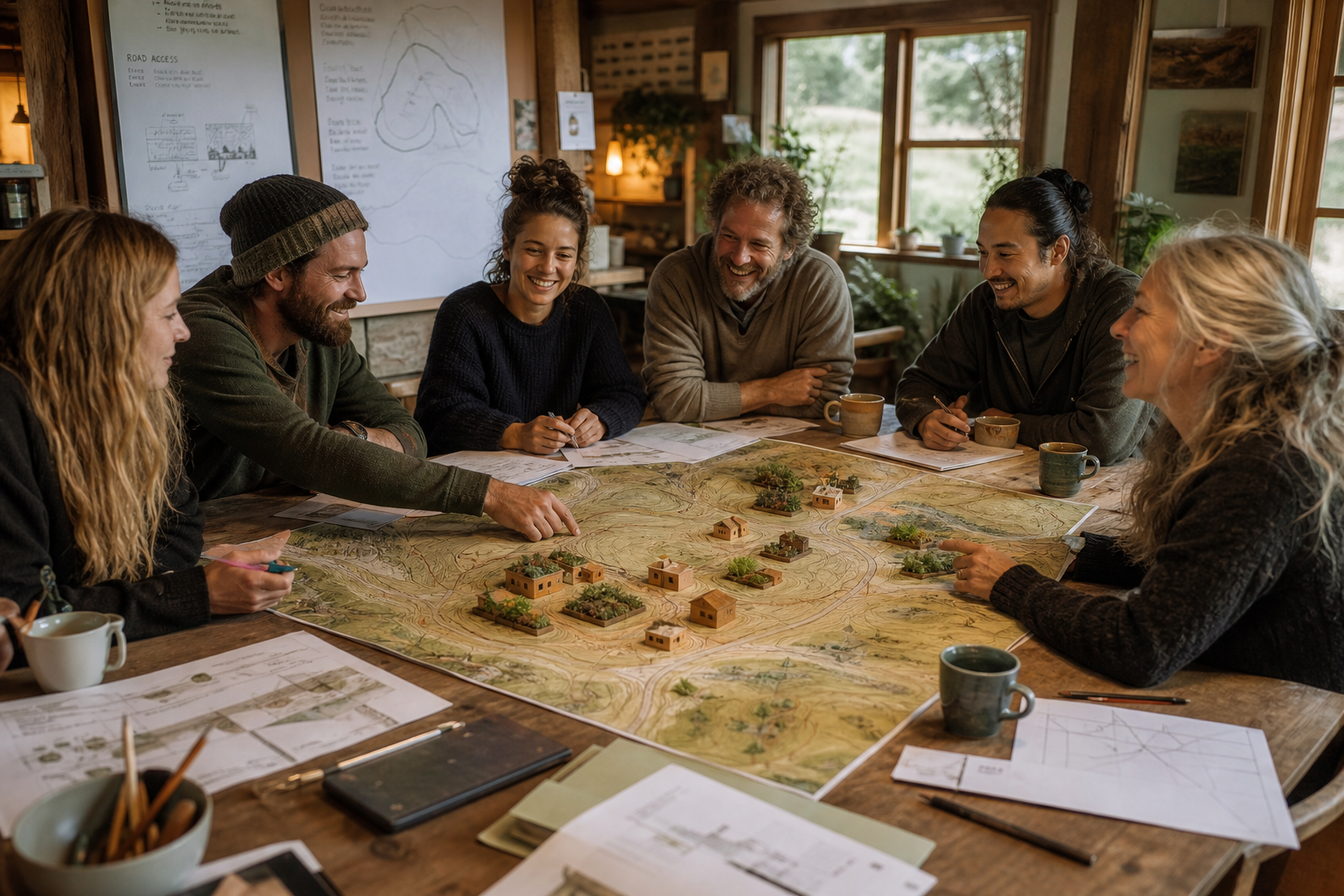
Meanwhile, our team is drawing sample plans on candidate parcels — measuring contours, sight lines, and access with survey gear, then sitting around tables moving model tiny houses and sheds across paper maps like a board game. It is how we learn whether a block can hold a pioneer camp, a Landing Zone, gardens, workshops, and the longer village that follows.
The rough shape we are looking for
Around one hundred hectares — not a precise number, but a scale that allows food production, shared infrastructure, and breathing room without becoming an industrial farm. A mix of rolling country and flatter fertile paddocks: Golden Bay often offers either very flat, flood-prone river flats or steep hillsides at eighty degrees, with less of the gentle contour that suits a village spread across a landscape. Some slope is welcome — up to about twenty-five percent — for orchards, terraces, and gravity-fed water. Beyond that, engineering costs climb fast.
Backing on to Kahurangi National Park is a strong plus: bush edge, biodiversity, walking access, and a sense of permanence. We are not looking for a block that is exclusively bush — we need arable soil for fruit and vegetables — but native cover on boundaries and ridges is a gift.
Zoning matters. Tasman District Rural 1 land — highly productive — is where we want the bulk of growing country. Rural 2, with its lower productivity rating, can still work well for infrastructure, housing clusters, roads, and the pioneer camp that must sit out in the wild lands, not tucked into an existing farmhouse where people might settle in and say, we are sorted, instead of building the shared arrival space our location-free tribe still needs.
Water, risk, and what we would rather not pay for
A good water story is non-negotiable: river frontage, a reliable stream, licensed bore, spring, or a combination that can feed gardens, people, and fire resilience through dry summers. Existing dams can be genuinely useful. Established fruit trees are a welcome head start. An on-site quarry, if responsibly managed, can reduce the cost of paths, foundations, and local building stone.
What raises the price without helping us much? Existing houses in the wrong places. A dwelling where we need the pioneer camp, or a cottage that anchors the layout around yesterday's farm rather than tomorrow's village, often costs more than it saves. We are not anti-house — we will build plenty — but we would rather not inherit structures that dictate a layout we would never have chosen.
We are also screening out flood-prone river flats and tsunami-vulnerable coastal strips. Proximity to a beach is wonderful for recreation and spirit — Golden Bay does beaches well — but the land itself should sit above the line where climate and tide become daily anxiety.
How ownership would need to work
NeighbourGood has watched too many well-intentioned communities stumble when land stayed in private hands while everyone else invested labour, hope, and savings. Sob stories abound. Authority fractures. When the landowner's circumstances change, everyone downstream pays.
For us, the land needs to end up owned by the collective company that holds village businesses and tenure — equal shareholders, clear governance, sociocratic consent. That is not negotiable because it is what keeps the ultimate authority with the people who live the project, not with a single titleholder who can sell, subdivide, or fall out with the group.
That said, we are open to creative starts. A landowner might contribute their block as their membership joining fee and capital contribution — a partial pay-down now, with a structured path to full collective ownership as the village proves itself. We would rather design that journey honestly at the beginning than pretend a loose handshake will hold for decades.
What happens next
If you own land that sounds close — or if you are the cousin who knows the cousin — we would like a conversation before anything formal. No pressure, no valuation dance on day one. Tell us what you have, what you want for it, and what you would want for yourself and your whānau if a regenerative village became your neighbour rather than a subdivision.
We will keep testing candidates against our criteria, publishing what we learn, and refining the ask as real paddocks teach us what paper plans cannot. When capital and community align, we want Golden Bay locals to already know who we are and what we are trying to build — a place to land, grow, collaborate, and belong.
Stay informed, join the team, or read about enabling capital if you want to walk this path with us.